

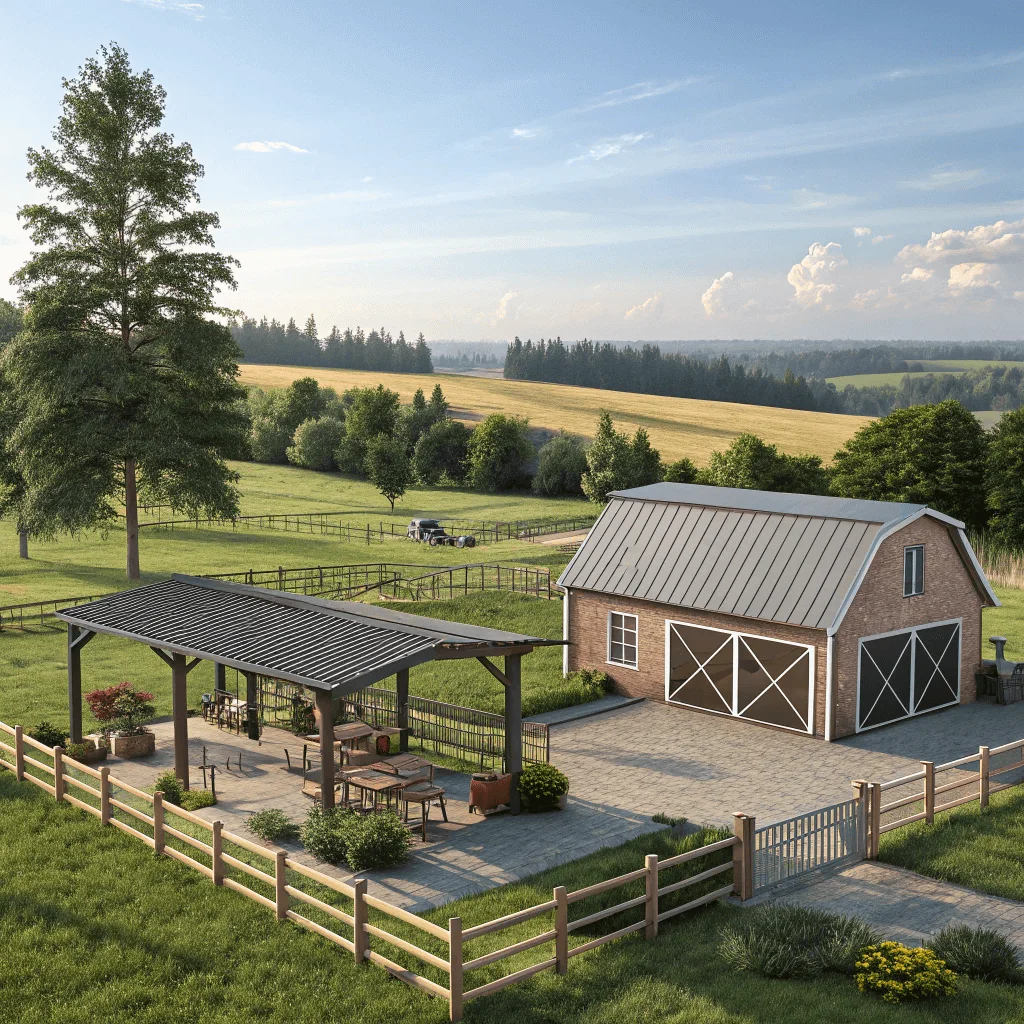
Some folks dream of the country, while others already call it home. Either way, people often think of country living as a carefree space filled with green pastures, wildlife, and a general sense of peace and tranquility. While all that is true, it’s not all sunshine and dandelions.
Someone has to keep the yard weeded, feed the animals, repair the fencing, and cover the old tractor.
That is where thoughtful outdoor structures come in.
Good shelters serve many purposes beyond simply being a convenient way to lay out your land. Good shelters make your daily activities easier and provide a safe place to store your important tools and animals, thereby reducing much of the hard work. Good shelters aim to make life easier and eliminate the need for continual readjustment to the weather, storage space, and other needs of your livestock.
From barns to sheds to temporary shelters, outbuildings transform farmland into a place of action and use.
Many outdoor structures and features of rural properties significantly ease life in rural areas.
Equipment Sheds That Protect What Keeps Your Land Running
Most rural farms and homes require heavy equipment to function. Tractors, lawn mowers, trailers, and attachments are necessary for farming and maintaining driveways and pastures. Due to heavy use, heavy equipment and attachments need to be properly protected from the elements to prolong their lifespan.
An equipment shed solves this problem straightforwardly.
Used for protection from the rain, snow, and sun. They can also be used for frequent entry and exit by heavy equipment. An “equipment shed” does not refer to a traditional full garage. Rather, a wide opening with a high clearance to enable heavy trucks to be backed in and out without having to be turned in the opening.
For many of our customers, it’s only after they have used their new equipment shed for a season or two that they truly begin to understand and appreciate the value of their investment. Storing tools and other equipment in a single, convenient, dry location greatly simplifies daily tasks. What used to be a chore of searching from building to building and or constantly moving equipment from the weather to use can be greatly reduced.
And that kind of efficiency adds up over time.
Storage Buildings That Keep Supplies Organized
People who live in the country typically need a wide assortment of supplies on hand. Feed bags, fencing supplies, tools, seasonal equipment, and building supplies are just a few examples. If there were a proper place to put everything away, all the extra supplies would be much neater and confined to specific areas, such as a barn, a garage, and outdoor storage.
A well-designed storage building helps restore order.
Our Farm Buildings include utility sheds and multi-room barns. Your needs on your land may call for something small, or a larger building composed of several separate rooms to accommodate all your needs: tools, animal supplies, and household equipment.
Organization might seem like a relatively unimportant aspect of our daily lives, but in actuality, it has a huge impact. Take, for example, the simple act of restocking school supplies in an easily accessible location so they are always quick to grab and can’t become damaged by excess moisture, insects, or pest infestations.
It also helps protect your original investment in your tools and materials.
A storage shed is one of the few structures that will likely be used extensively over time.
Horse Barns That Support Animal Care and Daily Routines
For properties that include horses, a well-built horse barn becomes the center of daily activity. Horses require consistent care, shelter, and safe spaces for feeding and grooming. A thoughtfully designed barn makes these responsibilities much easier to manage, which is why careful planning during horse barn construction plays such an important role in how the structure functions day to day.
Horse barns typically include individual stalls that give each animal a secure, comfortable place to rest. Proper ventilation is essential so fresh air circulates through the building, helping maintain healthy conditions throughout the year. Wide aisles allow room to lead horses safely, store tack, and perform routine grooming or health checks.
Many barns also include a tack room for saddles, bridles, and riding equipment. Having a dedicated space for these items protects them from dust, moisture, and temperature changes.
But beyond their functional features, horse barns often serve as daily gathering places on rural properties. Mornings might begin with feeding routines and quiet moments in the barn aisle. Evenings often end there as well, checking stalls and settling animals for the night.
In that way, the barn becomes more than just a shelter.
It becomes part of the rhythm of rural life. When designed properly, horse barns make animal care safer, more organized, and far more efficient for the people responsible for it.
Run-In Shelters for Simple Livestock Protection
Not all animals need a full barn. Many types of livestock can make do with a run-in shelter.
Run-in shelters are just simple three-sided structures that allow unlimited entry and exit for your animals. These shelters protect from precipitation, wind, and sun while still allowing your animals to remain outside.
These shelters are used for horses, cattle, goats, and other grazing animals. Because they are easier to build than a full barn, shelters can be a good compromise for larger pastures.
Location is key when building a run-in shelter. You’ll want to position it on slightly higher ground to avoid standing in mud and ensure adequate drainage. Also, it’s helpful to position the shelter either facing directly into the wind or directly away from it, depending on the time of year.
When used properly, these simple structures lead to healthier animals while still allowing animals access to the open pasture.
Workshop Spaces That Make Rural Projects Possible
If you have spent any time at all living on the land, you’ll know that there are always jobs to be done. Fencing will need fixing, equipment will need servicing, and skills such as woodworking, welding, and mechanics will be needed.
The reason is that a workshop on a property can be one of the most valuable components of that land.
Storage buildings are meant for storage, but workshops are meant to be used. Workshops can have workbenches, power, lighting, and storage for hand tools and equipment. Having a place to do repairs and construction keeps the garage and yard from becoming a work site.
With cold weather setting in, being able to work comfortably in an indoor workshop is a great advantage.
Over the years, many rural landowners find that their workshops evolve from places where hard work is done to places where imagination comes to life, and their ideas are turned into tangible projects they can use on their land to improve their properties and buildings.
The orchard is frequently the gardener’s own personal source of joy. And often, it becomes one of the most personally satisfying spaces on the property.
The Role of Practical Design in Rural Living
In rural areas, the outdoor structures built on the property are more than just additions. They determine the property’s functionality and can affect the land’s productivity for years to come. Wisely placed structures can minimize foot traffic on the land, protect valuable assets, and make duties on the land easier to fulfill. The key is thoughtful planning.
When we build for the tasks of everyday country life, we avoid interfering with that natural way of life. Our buildings protect our equipment, provide comfort for our animals, and make it easy and convenient to reach and use our tools.
And the property’s caretakers spend less time dealing with little everyday affairs. That shift helps give you more time for the things you enjoy about country living — the things that brought you here in the first place.
Open spaces, early mornings, and the feeling of having created something durable and reliable.